

SMK Typhoon Helmet with Visor 115/24/MA200 – Matte Black
Add to cart to update your progress.
Estimated delivery
Contact us to confirm delivery for this variant.

Unfortunately, this product is no longer in stock.
However, we can notify you when it becomes available again.
SMK Typhoon Full-Face Helmet MA200 – Matte Black
The SMK Typhoon 115/24/MA200 is a full-face motorcycle helmet in matte black, designed for everyday road riding, sport-touring, and longer journeys. Its compact, aerodynamic shape provides excellent protection for the entire head and face, while the ventilation system enhances comfort during rides.
The helmet is made of durable thermoplastic, equipped with an internal sun visor, a removable inner liner, and a practical Microlock micro-adjustment buckle. ECE 22.06 homologation confirms compliance with the current European safety standard for motorcycle helmets.
Key Features
- ECE 22.06 Homologation – compliance with the current European safety standard.
- Full-face design for protection of the entire head, face, and chin.
- Thermoplastic shell with an aerodynamic and compact shape.
- Integrated internal sun visor for protection against glare and strong sunlight.
- Wide clear external visor for good visibility during rides.
- Pinlock ready – compatible with Pinlock 70 or Pinlock 30 inserts, depending on the visor version.
- Microlock micro-adjustment buckle for quick and precise fastening.
- Removable inner liner for easy cleaning and maintenance.
- Ventilation openings in the chin area and the upper part of the helmet.
- Suitable for sport-touring, daily commutes, and longer trips.
- Unisex design – suitable for men and women.
Technical Specifications
| Brand | SMK |
| Model | Typhoon Solid |
| Color Code | MA200 |
| Color | Matte Black |
| Helmet Type | Full-face |
| Shell Material | Thermoplastic |
| Shell Shape | Compact and aerodynamic |
| Buckle Type | Microlock micro-adjustment buckle |
| External Visor | Clear, wide-angle, and replaceable |
| Internal Sun Visor | Yes |
| Pinlock Ready | Yes, compatible with Pinlock 70 or Pinlock 30 |
| Pinlock Insert Included | No, unless stated otherwise for a specific version |
| Ventilation | Front and upper ventilation openings |
| Removable Inner Liner | Yes |
| Weight (sizes XS–M) | Approx. 1575 g ± 50 g |
| Weight (sizes L–XL) | Approx. 1675 g ± 50 g |
| Homologation | ECE 22.06 |
| Gender | Unisex |
| Available Sizes | XS, S, M, L, and XL |
Size Chart
| Size | Head Circumference | Approximate Weight |
|---|---|---|
| XS | 54 cm | 1575 g ± 50 g |
| S | 55 cm | 1575 g ± 50 g |
| M | 57 cm | 1575 g ± 50 g |
| L | 59 cm | 1675 g ± 50 g |
| XL | 61 cm | 1675 g ± 50 g |
To choose the correct size, measure your head circumference with a measuring tape approximately one centimeter above your eyebrows and ears. The helmet should fit evenly across your entire head and should not move or slide independently when you move your head.
What does ECE 22.06 homologation mean?
ECE 22.06 is the current version of the international safety standard UN Regulation No. 22 for protective motorcycle helmets. Homologation confirms that the helmet type has been tested according to prescribed procedures and meets the required conditions for protection, construction, fastening system, field of vision, and other safety features.
The ECE 22.06 standard uses more demanding and extensive tests than the previous ECE 22.05 version. Helmets are checked at various speeds and across multiple shell areas, which better assesses their performance in different types of road and off-road accidents.
What is checked under the ECE 22.06 standard?
- Impact energy absorption – verifies how much energy the helmet transfers to the head upon impact.
- Impacts at various speeds – the helmet is tested at multiple load levels, not just at one speed.
- Multiple impact zones – different parts of the shell are tested, including additional randomly selected points.
- Oblique or rotational impacts – the load that can cause rotational movement of the head is also assessed.
- Shell strength and internal protective layer – verifies the construction's ability to withstand prescribed loads.
- Helmet stability on the head – the helmet must not easily come off or slide from the head during an accident.
- Buckle and chin strap strength – the fastening system must remain closed and correctly positioned even under significant loads.
- User's field of vision – the helmet's construction must not dangerously restrict visibility while riding.
- Accessory safety – accessories and attachment points must not reduce the helmet's protective properties.
Spare parts by brand
-

Spare parts for KuKirin
332 products -

Spare parts for Engwe
162 products -

Spare parts for Segway Ninebot
118 products -

Spare parts for Xiaomi
150 products -

Spare parts for ECO Speed
102 products -

Spare parts for VSETT
64 products -

Spare parts for Teverun
42 products -

Spare parts for Kaabo
59 products -

Spare parts for Joyor
41 products -

Spare parts for NAMI
23 products -

Spare parts for Langfeite
19 products -

Spare parts for Dualtron
130 products -

Spare parts for Hiley
24 products -

Spare parts for Kugoo
29 products -

Spare parts for Urbanglide
5 products -

Spare parts for Giant
17 products -

Spare parts for KingSong
515 products -

Spare parts for Veleco
1217 products -

Spare parts for Cube
9 products -

Spare parts for Canyon
6 products -

Spare parts for Scott
15 products -

Spare parts for ECONO
9 products -

Spare parts for Trek
11 products


Why choose EVOLT?
Tržaška cesta 222, 1000 Ljubljana
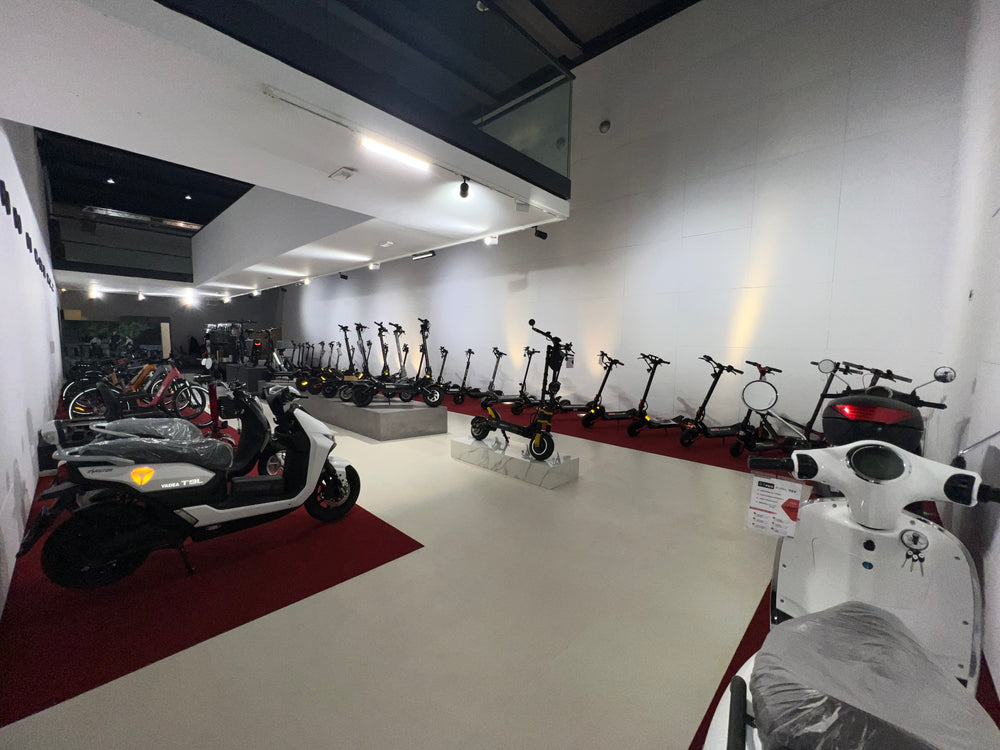
Our showroom in Vič, Ljubljana, offers 200 m² of space, bringing sales, servicing and spare parts together in one place.
You can view and try out products in person, and after purchase we provide local servicing, expert support and prompt spare-parts delivery.
MON–FRI: 9:00–19:00
SAT: 10:00–16:00

1,000+ spare parts
In stock in Ljubljana
EVOLT is a specialized provider of spare parts for electric scooters, e-bikes and other electric vehicles.
Discover a wide range of quality spare parts and components in stock in Slovenia with fast delivery in 1–2 working days.
We offer reliable supply for both end customers and business partners, workshops and retailers – with options for retail and wholesale.
-

KuKirin × EVOLT Performance Edition: electric scooters for riders who want more
These are not just standard electric scooters with a new...13 min read -

Archive: 2026 e-bike subsidy application (programme ended)
Archived guide for the former electric bike subsidy application. The...1 min read -

KuKirin error codes: what do the errors on KuKirin Electric Scooters mean?
An error code is a diagnostic message that the scooter...13 min read -

Ultimate guide to choosing an ECONO e-bike (2026 Series): Analysis of all models
Choosing the right electric bike is often complicated due to...6 min read -

Archive: electric bicycle subsidy 2026 (programme ended)
Archived article about the former electric bicycle subsidy programme. The...1 min read -

Electric scooters are safe if we know how to use them: how to properly maintain the battery and why buying cheap from abroad does not pay off
In this article, we reveal how to take care of...6 min read -

Riding electric scooters and mopeds from now on only for those over 15 years old
Slovenian legislation in the field of micro-mobility has undergone a...4 min read -

Unitree Robots: The Future of AI at EVOLT
We are proud to announce that eVolt has become the...4 min read


